
Haematology
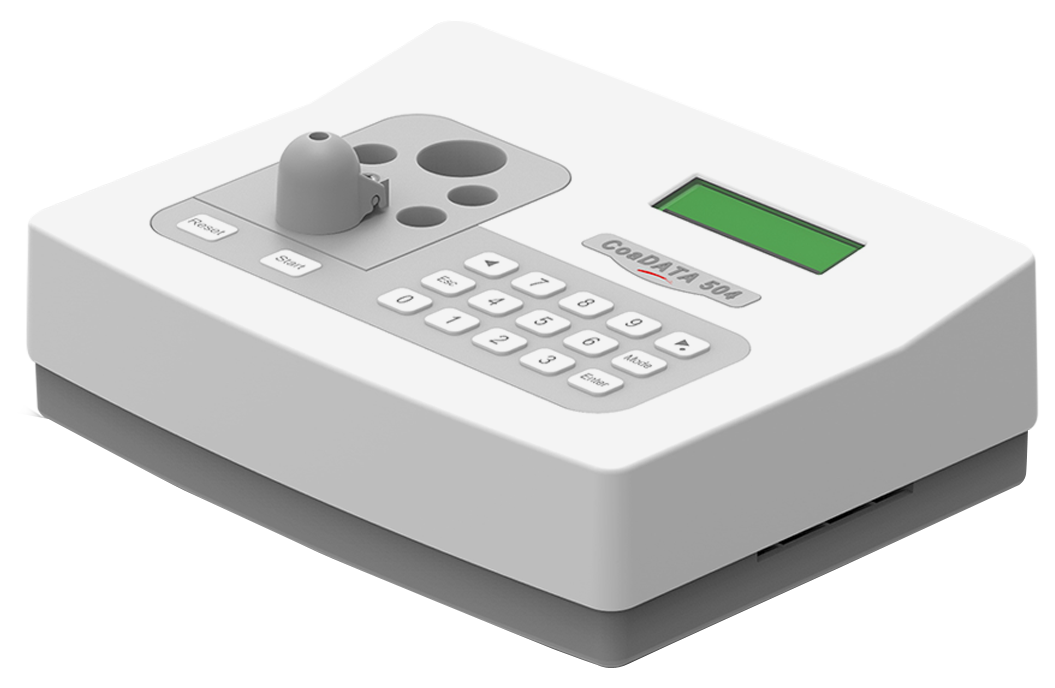
CoaDATA 504
CoaDATA 504 Semi automated, Single channel coagulation analyser for clotting assays
CoaDATA 504 Semi automated, single channel coagulation analyser for clotting, chromogenic and immunoturbidometry assays based on turbodensitometric measuring principle with auto start function.
The analyser operates according to the opto-mechanical measuring principle, offering large range with higher accuracy and precision compared to only optical detection priniciple.
A light beam passes through the cuvette containing the test plasma onto a photo detector. Any change in the intensity of the transmitted light, that is light increase or decrease, is converted into an electric signal. Hence, even the most unstable clot can be detected.
The period from adding the start reagent until clot formation is measured. It then can be converted into the appropriate units (%, ratio, INR, mg/dl, g/l). Once the start reagent has been added, the measuring channel is adjusted, that is the lamp intensity automatically adjusts up or down depending on the turbidity of the test sample. In this process the turbidity of the sample plasma and the reagent are adjusted.
A mixer is located in the cuvette. During the measuring process the mixer provides homogeneity of the reagent-plasma medium. At the same time a small whirl emerges through the mixer movement which assures that even the smallest fibrin clot is formed in front of the photo detector.
This stirring action combined with the optical measurement constitutes the basic features of the patented turbodensitometric measuring principle

The light source is an LED (1) with narrow-band emission spectrum. The emitted light from LED1 (405nm) and LED2 (750nm) is divided into a measuring beam 1 and a measuring beam 2 by use of a beamsplitter. Each of these beams is focused by means of the collimator lens and aperture to a parallel beam of light. The light beam passes through the cuvette (2) to the photosensitive receiver (3). The generated current and the resulting voltage (4) at the photosensitive receiver is proportional to the received light as long as the component is operated within the optimal range. If a photo transistor is used, the voltage conversion is already integrated, by use of a photodiode the conversion must be done by a operational amplifier (5) circuit. The resulting voltage must be increased in order to adapt the input voltage range of the AD converter(6). The absorbance value (Extinktion) of the light is calculated from the transmission value. The Beer-Lambert law is used.
The reaction curve consists of periodically collected measuring values. The curve can be calculated by use of specific algorithms to detect the reaction time or to determine the reactivity of a substance in the sample.
Due to the fact that the mixer motor underneath the measuring channel can be configured for continuous or temporarily stirring traditional clotting tests according the turbodensitometric principle or chromogenic tests can be performed.
- Single channel semi automated device based on the well established measuring principle.
Very compact instrument based on LED photometric/clotting, to handle all routine clotting assays with CoaDATA 504 - The system needs only low end volumes for measurement.
Saves a significant cost on the test reagents. - The basic version can be equipped with external printer, external barcode reader.
Small or big workloads, the same level of accuracy and convenience for integrity of results.
Offering great ease of operation and convenience for all routine and special tests. - The system has facilities for 15 editable tests with provision for test order selectability and convenience of test input.
In a small footprint the systems offer convenience normally found in much more expensive machines. - CoaDATA 504 incorporates turbo densitometry method (opto mechanical)
The unique technology permits analysis of routine and chromogenic test and delivers precise and reliable results. - The systems despite the small size have extensive features – LIS capability, patient ID entry, LIS/Host (USB) and interfaces including RS 232, USB, SD-card for result management and software update in such a compact unit.
Extensive capabilities with the hardware and software, comparable to high end high cost systems in a compact small device. - The test throughput is of the order of 30 PT, and 15 APTT per hour with an excellent sensitivity of 1gram /litre for fibrinogen.
The ideal system for labs with growing needs with results, reliable and comparable to larger analysers. - The mixer speed in the cuvette is selectable between 200 and 1000 RPM depending on the test method.
Provides for easy methods development and adaptation to specific test conditions, for precise and repeatable results. - The software structure permits differentiated access for parameter set up, parameter printout and service password and task, with four level password.
Ensures integrity of the data, including the programmes and the results features available with bigger systems.
CoaDATA 504
Type of analyzer:
Semi-automated 1-channel in-vitro-diagnostic analyzer for coagulationApplication:
Clotting testsOperation:
ManualMeasuring principle:
TurbodensitometricSensitivity:
~ 1 g/l Fibrinogen; PT 10% of normTest throughput:
~30/h PT, ~15/h aPTTCuvette volume:
min. 150 μl, max. 200 μl (test suspension)Calibration:
Manual input of calibration points, method dependentSoftware:
Stored in MemoryPre-programmed methods:
aPTT in sec, and RatioFibrinogen, in sec, [g/l] and [mg/dl]
Thrombin Time (TT), in sec
Intr. Factor, in %
Extr. Factor, in %
Light Source:
LEDWavelength:
Approx.875nmDisplay:
Liquid crystal display, 2 lines with 20 characters eachThermal Block:
Temperature controlled at 37.4°C +/ -0.4°CMeasuring channel(s):
1Light protection caps:
1, designed for yellow pipette tips by EppendorfReagent vial positions:
oneCuvette positions:
4 for pre-heating/incubationMeasuring time:
Max. 420 secMixer:
200 – 1000 rpm, depending on test methodCoaDATA 504
The CoaDATA 504 is a semi-automated 1-channel in-vitro diagnostic analyser for coagulation, based on the turbodensitometric measuring principle. The anlayser is capable to perform a wide range of tests such as prothombin time, activated and partial thromboplastin time, fibrinogen, and single factor assays. The diagnosis and control of coagulation parameter is performed in the combination with several reagents for coagulation diagnostics.
- Single channel coagulation analyser based on turbodensitometric and photometric principle of measurement for accurate results.
- The machine shall have two line LCD display and key pad for easy operator guidance and navigation, and display of results and provision for external printer and or barcode scanner.
- The optics shall be based on LED photometer for analysis, based on unique turbodensitometry.
- The system shall have reference channel and ambient light rejection facility for enhanced sensitivity.
- Shall have capability to perform all the routine (i) clotting tests like PT, APTT, fibrinogen (ii) Thrombin Time, Bactroxobin (iii) Extrinsic and Intrinsic factors (iv)Protein C and Protein S by clotting
- The test throughput shall be approximately PT ~ 30/hr and APTT ~ 15/hr.
- The system sensitivity shall be ~ 1 g/l for fibrinogen.
- Should have facility for programming and storing of at least 15 tests, and freely editable.
- The software shall have facility for at least two nos. of nine point calibration curve, and editable, with automatic result calculation facility.
- The machine shall have provision for positive patient identification manually or with a barcode scanner, and data export to LIS.
- The interface capabilities should include as standard, RS232, USB and memory for software update, and result management.
To know more about CoaDATA 2004
Download BrochureFrequently Asked Questions
Turbodensitometry is the principle of measurement, with a proven track record over several years with 504, and 504+ combines the proven turbidodensitometry with LED photometry.
It is based on long life LED diode with 504, and in case of 504+, it is LED photometric, with two wavelengths.
It is in IR region for 504, and 405nm and 750nm in case of 504+.
Yes, with 504+, and 504 does not have reference channel.
Yes, the 504+ has the feature, and not available with 504.
Yes, in case of 504+ nine point calibration curve is supported, but not in 504.
Two calibration curves can be stored on-board with 504+. It is not available in case of 504.
There are 15 tests which can be stored and recalled from memory.
Yes, the system(s) can be connected to external printer Seiko Epson DU414 or equivalent.
Yes, when equipped with optional barcode reader.
- RS232
- USB
- SD-card for result and software management
- External barcode reader.
Yes, LIS/HOST (USB) and LIS protocol (unidirectional) facilities are available.
No, the cuvettes come with “cuvette card” for tracking of cuvette usage and only cuvettes supplied by LABiTec can be used.
No, the system 504+ is sensitive to and not affected and free from interferences from hemolytic, icteric and lipemic samples.
504+ shares majority of features with 504 except for the fact that 504+ can also handle
- Chromogenic substrate based assays (eg. protein C, ATIII etc.),
- Immunoturbidimetry tests (e.g. D-Dimer)
- 504+ is equipped with measuring technologies for turbodensitometric and photometric tests at 405 and 750nm,
- Employs unique dual- wavelength technology
- Insensitive to lipemic, icteric and hemolysed samples
- Nine point calibration curve, two nos. are supported.