
Haematology
CoaLAB 1000
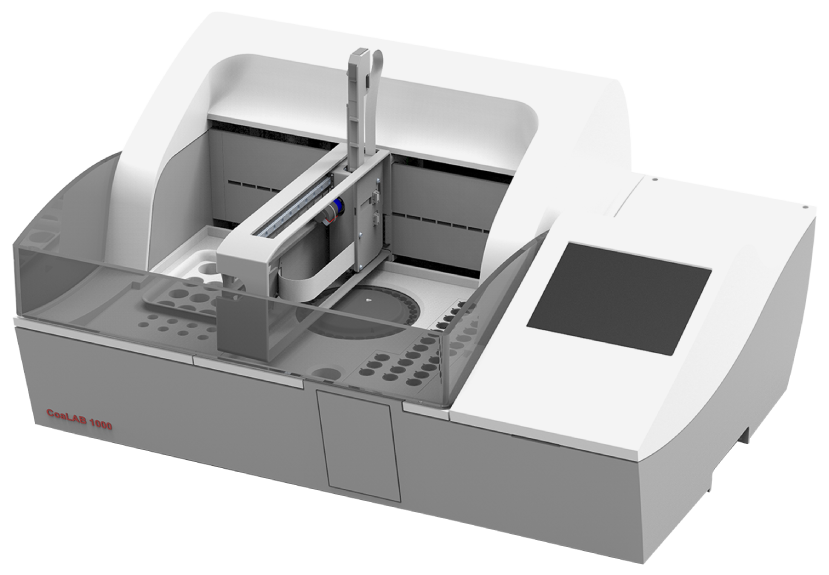
CoaLAB 1000, compact bench top fully automated clotting, chromogenic and immunoturbidimetric coagulation analyser for precise and reliable results over the entire coagulation spectrum.
CoaLAB 1000, Compact bench top fully automated clotting, chromogenic and immunoturbidimetric coagulation analyser for precise and reliable results over the entire coagulation spectrum
MEASURING PRINCIPLE
The analyser uses a photo-optical detection principle. Clotting, chromogenic and immunologic assays can be run simultaneously in random access, depending on the available wavelength installed in the analyser.
The measuring module consists of the measuring rotor having two measuring channels each equipped with LED photometer. Depending on the analyser there are either
– 2 LED photometers with a filter 405nm only or
– 2 LED photometers with filters at 405nm/570nm/740nm

A light beam passes through the cuvette and is received by the photodiode. As soon as the starting reagent is added to the plasma, the measuring time starts.
Any change in the light transmittance is detected and converted into an electrical signal by the photodiode. When the assay is complete, the raw data (seconds for coagulation assays and mE/sec (Extinction) for chromogenic assays) are processed and reported.
Totally automated two channel coagulation analyser for clotting, chromogenic and immunological assays.
Capable of performing routine clotting assays like PT, APTT, fibrinogen, thrombin time, ecarin time, batroxobin, factor assays and latex assays like D-Dimer, CRP and chromogenic assays like AT3, protein C, plasminogen, α 2 antiplasmin, as well as tests like Factor V Leiden, LA, PiCT, TDT, and TAFI etc.
- The system offers comprehensive testing capabilities covering most coagulation tests including routine, special and emerging tests, addressing future needs as well.
Touch sensitive LCD display with on board graphic user interface, and no need for external computer.
- Provides easy guidance for operator and intuitive software for easy operation and usage and minimum space requirement.
The system is based on the photometry with magnetic stir bars to homogenise the approach and to increase the sensitivity.
- Based on the well proven and unique principle combining the best of photometry and continuous mechanical stirring, for precise results even in the case of tests involving fragile clots.
Two channel LED photometer with two reference channels.
- Relatively impressive throughput of 120 PTs, 60 APTTs and 80 fibrinogen tests per hour, in a compact foot print and precise results, thanks to referencing.
Has 32 cuvette ring rotor, 22 sample positions for the primary and or secondary tubes, and 15 regent positions and three stat positions.
- Provides for carrying out a number of tests without the need for exchange, or intervention with total automation, adequate and practical in most laboratory conditions.
The test volume is 150μl typically and 300μls maximum, providing for easy
adaptation to different tests and methodologies.
- Offers economy of scale for the expensive tests, with flexibility for easy adaptation of specific and appropriate reagents, to suit the lab requirement.
Provides for automation with result calculation in percentage, INR, ratio, mg/dl, g/l, μg/ml etc. automatic predilution of the samples, automatic repeat function, automatic calibration and so on.
- Total automation, in every practical aspect providing greater level of convenience and accuracy.
Memory of 10,000 results and curve data on internal SD-card.
- Helps in tracking the activity curve, and helps in easy diagnosis of certain abnormalities, providing the function what is known as “wave-form analysis” and first adapted by LABiTec!
Large data storage capacity without PC and associated hardware.
Patient ID can be entered manually, or, with the optional barcode scanner, in addition to on-board barcode scanning facility.
- Fail proof back-up for sample i.d. with entry of patient identification to avoid sample mix up even in the unlikely event of barcode scanner failure.
Internal USB interface for easy adaptation of other assays and field software updates.
- Ensures easy system upgradation in the field and protects against obsolescence.
Offers positive barcode identification and with the bi-directional host query/LIS communication as standard.
- Hassel free data transfer with host query for great convenience and data handling.
The CoaLab 1000 automated open system to reagents, quite compact in its design and big in performance, occupies very little bench space, offering great ease of use while incorporating all the features normally seen with larger and much more expensive analysers, with the ideal throughput which in most situations is adequate for medium and high end facilities without huge initial investment, but a system that meets your needs today and well into the future under Indian conditions.
CoaLAB 1000
Type of instrument:
Fully automated coagulation analyzerApplication:
Coagulation, Chromogenic, Immunology testsWorking methods:
Sample oriented, Test selective, STATMeasuring principle:
Photometric; with magnetic stirrers to homogenize the test mixture and increase the sensitivityLight Source:
LED, light emitting diodeCuvette:
Volume between 150μl and 300μlTest throughput:
PT 120/h, aPTT 60/h, +/- 20 tests/hCuvette volume:
min. 150 μl, max. 300μl, test dependentMeasuring channels:
Two measuring channels atthree wavelength 405/570/740nm
Calibration:
Manual input of calibration points with 7 points, maximum two calibration curves for each test orAutomatic calibration
STATS:
STAT loading is possible at any time in up to three assigned positions. Routine testing can be interrupted for STAT loading and then automatically giving priority to the STAT sample Analyzer data reagent positions: 15 positions at room temperature(R1-R3) for 15ml reagent vials (left/right pos. stirred)
– (R4-R15) for 5ml reagent vials.
Washer positions:
2 positions at room temperature(W1-W2) for washer and cleaner
Calibration/Dilution:
8 positions at room temperature(C1-C8) for controls, calibrators & dilutions
Sample positions:
2×11 positions for primary and secondary tubes/cups1×3 positions for STAT
Measuring rotor:
One heated measuring rotor at 37°C +/-0.4°C with two measuring channels, designed for cuvette rings.Cuvette rings:
Ring with 32 cuvettesWash Station:
One, for pipettor cleaningPipettor:
Capacitive, movable in three directions x, y and zHeated to 37°C:
Dilutor 250μl syringe:
Minimal dosing 2μlMaximal dosing 250μl
Resolution: 12 half steps for 1 μl for 250 μl syringes
Level sensors for distilled and waste water containers
Rinsing:
Two modesRegular with distilled water
Four intensive with washing solution for probe cleaning as with Thrombin inactivator
Cleaning:
Pumps and tubing with cleanerDisplay:
Touch sensitive colour displayVisible area:
11.5×8.7cmDisplay resolution:
320 x 240 pixels, ¼ VGA).Software:
Linux based operating system with Graphic User InterfaceProgrammable methods:
50 reagents/tests can be freely programmedInterfaces:
1x USB for external printer device1x USB for USB memory device
1x LAN for external PC connection
2x RS 232C Serial interfaces
1x external barcode scanner connection
CoaLAB 1000
The CoaLAB 1000 named hereafter as analyser, is a fully automated photo-optical
blood plasma hemostasis instrument capable of performing clotting, chromogenic* and immunoassays* simultaneously in random access or batch mode from primary and secondary tubes.
For in-vitro diagnostic use only!
* Depending on the analyser model the system is capable to perform a wide range of coagulometric, chromogenic and immunologic coagulation tests such as Prothrombin time, activated and partial Thromboplastin time, Fibrinogen, derived Fibrinogen and special tests such as single factor assays, Anti-Thrombin III, Protein C, Protein S, C-Reactive Protein, D-Dimer and others based on the wavelength available in different analyser types.
Automated Coagulation Analyser
Totally automated bench top coagulation analyser which (i) shall be a stand alone device, without calling for external PC and monitor to control and run software and save space. (ii) Can permit flexible add-on field upgradable software to protect against obsolescence. (iii) Can offer various wavelengths to cover all major coagulation tests existing and emerging.
- Instrument type – Fully automated coagulation analyser for the clotting, chromogenic and immunologic testing with cover for safety.
- Display – Touch sensitive colour display with on-board graphic user interface.
- Measuring principle – Photometric LED photometer (405nm, 570nm, 740nm) with two reference channels.
- No. of measuring channels – Two, simultaneously.
- Measuring unit – Controlled at 37ºC ± 0.4 ºC. or better in a ring rotor, housing a minimum of 32 cuvettes.
- Sample/reagent platform – At least 2×11 Sample positions for various primary and secondary tubes, between 1.7 and 4 ml.
3 – 5 Stat positions.
Minimum 15 x Reagent positions (3x15ml) stirred, (12x5ml) non-stirred. Removable reagent tray for overnight cooling/ storage.
8 -10 Positions for controls and dilutions.
2 x Wash/cleaner positions with variable wash cycles. - Sampling – Dilutor, 2 to 250µl, volume freely programmable with capacitive sensor for pipetting, that can move in three directions. Pipettor ideally heated to 37ºC to preheat sample/reagent before testing
- Test volume – 150 µl typically and not exceeding 300 µl
- Maximum tests during same run – Ten tests per run depending on reagents/ buffers used.
- Assays to be covered – The following and not limited to routine clotting: PT, APTT, Fibrinogen, Thrombin time, Ecarin, Batroxobin etc.
Factors: Extrinsic (II, V, VII ), Intrinsic (VIII, IX,XI, and XII ) etc.
Thrombosis risk: Protein C, Protein S, Lupus anticoagulant, Factor V Leiden, APC-resistance, PiCT, TDT, TAFI and so on. Chromogenic: Protein C, Protein S, Anti-Thrombin III, Plasminogen, α2-Antiplasmin etc. Immunoturbidimetric : D-Dimer, CRP etc. - Data management – On-board QC package with Levy-Jennings plot, and Westguard multi rules.
- Software/hardware features – 50 or more programmable memory for reagents and test locations individually editable. Optimised cuvette consumption capability.
- Additional functions – Interface 2x RS232 barcode scanner
- 2xUSB device (printer)
- LAN (Host ) for bidirectional host communication.
- SD card, chip card loading unit.
- Power supply – 220V and 50 Hz. + 10%
To know more about Optical Aggregometer:
Download BrochureFrequently Asked Questions
System incorporates graphic colour touch display.
50 tests and 50 reagents are programmable and individually editable.
On board memory of upto 10,000 results and curve data on internal SD-card.
(i) Chipcard reading unit (ii) 2 x RS232 (1 x barcode scanner, 1x for service purposes ) (iii) 2x USB device (printer, USB stick) (iv) SD-card (only internal) (vi) LAN (Host)
Yes, software/parameters can be field upgraded via USB-stick, defying obsolescence of the analyser.
Auto repeat function, automatic calibration, and QC program are all standard. Build in service and maintenance software.
Temperature is controlled at 38 .4ºC ± 0.4 ºC
Dilutor range is 2-250µl in steps of 1µl
Yes, pipettor is heated to 37.4ºC± 0.4ºC before dispensing.
Capacitive pipetting device which moves in three directions.
A maximum of fifteen different reagent containers can be put on-board.
Yes, it does.
Can hold a maximum of 15 reagents with 3x15ml stirred, and 12x5ml non-stirred positions.
Reagent volume can be programmed between 2.0 and 250 µl.
No, there is no reagent cooling unit on board.
Two fixed racks of 11 samples each and three stat positions, totalling to 25 samples maximum can be handled at a time.
The minimum sample volume is 2µl.
Yes it can handle primary tube with the volume range 1.70 to 4.0ml.
The CoaLAB 1000 can handle several sample cups and tubes. Standard settings on board to select a LABiTec specific 4ml cup, Hitachi cup, short sample tubes (like Sarstedt, B&D, Venoject etc.) and long sample tubes as well.
Capacitive sensing is active in any case when a liquid has to be aspirated, that is, it is active for sample, reagent, QC plasma aspiration and independent from the vial, cup or tube type.
No, the pipetting device is not equipped with clot detection capability, at this point.
Yes, it can handle on-board sample dilution.
The system can accommodate a maximum of 2×11 samples, adaptable for different sizes of primary tubes.
Yes, positive sample barcode scanning is available with internal or external barcode scanner.
The system offers the flexibility of positive sample bar code identification by internal barcode reader as standard, or optional external bar code reader, if preferred.
There are eight standard/control positions available.
Analyser ensures precise and reliable result determination over the entire coagulation spectrum including
- PT (Seconds, % INR) , aPTT (Seconds, RATIO) , Fibrinogen according to Clauss (mg/dl, g/l), Thrombin Time (Seconds), Batroxobin Time (Seconds), Ecarin Test
- Factor deficient: Extrinsic Factors II, V, VII and X (PT based), Intrinsic Factors VIII, IX, XI, and XII (aPTT based).
- Thrombosis risk: Protein C (clotting test), Protein S (clotting test) , Lupus Anticoagulant, Factor V Leiden, APC-Resistance, PiCT (Prothrombinase induced clotting Time), TDT (Thrombin Dynamik Test), TAFI (Thrombin Activatable Fibrinolysis Inhibitor)
- Chromogenic: Protein C (Chromogenic), Protein S (Chromogenic), Anti-Thrombin III, Plasminogen, α2-Antiplasmin
- Immunoturbodensitometric: D-Dimer, C-Reactive Protein.
Yes, it is an open reagent system and reagents are reconstituted manually. But the reagents supplied through Wheecon are of high quality and optimised for use with the system and performance validated.
A maximum of 15 assays can be handled simultaneously.
A maximum of 50 different assays, and locations are individually editable.
No manual steps are not needed even in the case of factor assays.
The system incorporates long life LED photometer including reference channels.
The wavelengths applicable are 405nm or 405, 570 and 750nm.
The ring can hold a maximum 32 cuvettes, single use.
The software optimizes the use of cuvettes from the cuvette ring. The cuvettes not used in the ring are stored and will be used during the next run. There is a deviation from the approach during automatic calibration. A calibration will be done within one cuvette ring and not over two cuvette rings. In this case not used cuvettes cannot be used anymore.
The volume is 150 µl test in micro volume.
The measuring rotor and pipetting device are controlled at 38.4°C ± 0.4°C for measuring rotor and 37.4°C ± 0.4°C with pipetting device.
Yes there are three dedicated stat positions available.
Yes, provided with two washer/cleaner positions for minimising carry over.
QC program offered includes both Levy-Jennings chart and Westguard rules
Yes, auto test repeat function is available.
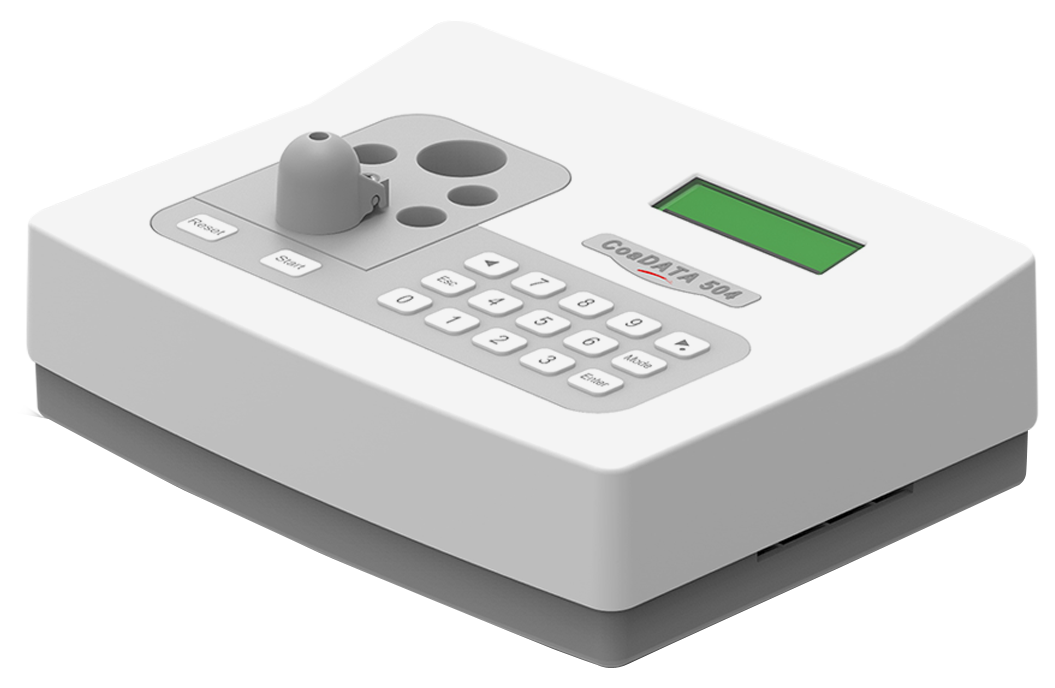
CoaLAB 1000 is a compact fully automated coagulation analyser.
CoaLAB 1000 is the most compact analyser in its category and well suited as
- Main system in medium to high workload centres under Indian conditions
- Reliable back-up system in referral labs and bigger analysers
- Dedicated analyser for consolidation of special tests.
CoaLAB 1000 analyser can handle tests in clotting, chromogenic and immunoturbitmetric modes.
The CoaLAB 1000 has two high-resolution photometric measuring channels, each equipped with upto three wavelengths.
Yes, the analyser can be continuously loaded for optimum throughput but without sample rack.
The measurement with CoaLAB 1000 is based on photometry, with magnetic stir bars to homogenise the test approach and to increase the sensitivity.
CoaLAB 1000 is the most compact analyser in its category and well suited as
- CoaLAB 1000 can perform the measurement by the use of stir bar inside the cuvette to have a better clot formation and hence better sensitivity for clot detection.
- The system can perform without stir bars those coagulation tests, where clotting is not involved.
Depending on the test approach, the throughput is 120 PT, 60 APTT and 80 fibrinogen tests per hour.
No, the system is self contained and external PC is not required to operate.
- What is the walk away capability of the system in terms of (i) specimen (ii) number of tests?
- 25 maximum (ii) greater than 10.
Yes, automatic calculation of MNPT is initiated if standard is lower than 100%.
Two calibration/reference curves can be assigned to each test and stored for recall.
Seven, and calibration curves are editable.
It is not possible to prepare a worklist > 22 patient sample in one batch. The preparation of the worklist is limited by the number of sample positions on board and during run following, patient samples can be loaded continuously.
Independent from the reagent cooling, the test calibration is necessary after change of the lot number and it is recommended to perform a weekly calibration.