

Haematology
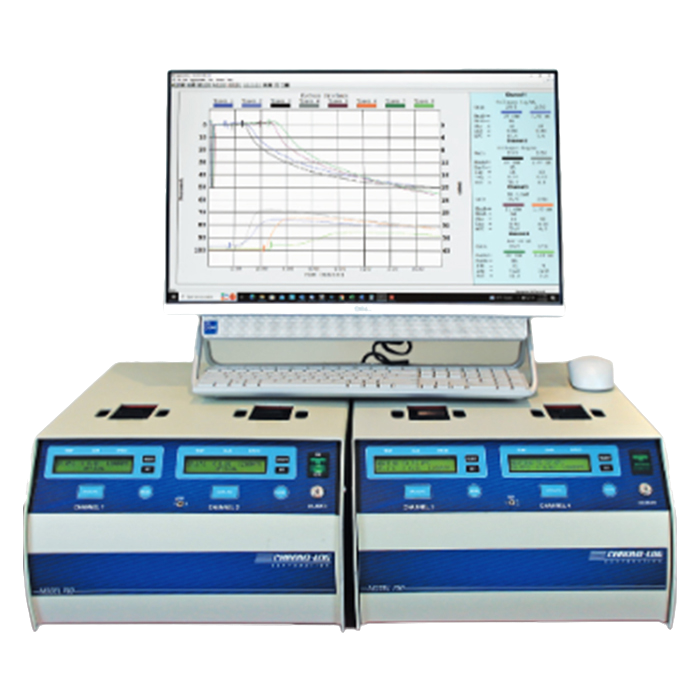
Whole Blood Optical & Luminescence 700-2 Two Channel
Whole blood/Optical Luminescence Aggregometer, with provision for whole blood and optical aggregation studies, for simultaneous ATP secretion studies in a dual or four channel version.
Whole blood/Optical Luminescence Aggregometer, easy to use with rapid results, provision for whole blood and optical aggregation studies, facility to use disposable or reusable impedance electrodes, ability for simultaneous ATP secretion studies and available in a dual or four channel version.
Optical method:
The Born-type aggregometer or optical aggregometer is a fixed wavelength spectrophotometer with a sample chamber (or chambers) heated to 37C. Provision is made for stirring of the sample because platelet to platelet contact is necessary to the determination of in vitro platelet aggregation. A beam of infra red light shines through two cuvettes, one containing PRP (the sample) and one containing PPP (the reference). The difference in light transmission outputs from the photodiodes is transferred to recording devices. The optical aggregation output is proportional to the continuously measured difference in light transmission between the test and reference samples. When a stimulus is added to the cuvette containing PRP and the platelets respond, changes in light transmission occur and are recorded over time.
PRP, which is a turbid, is stirred in a test cuvette maintained at 37C. The light transmittance through this turbid sample is measured relative to the PPP blank. When the agonist is added, the platelets will form increasingly larger aggregates and the PRP will begin to clear, allowing more light to pass through. This increase in light transmittance is directly proportional to the amount of aggregation and is amplified and recorded as a signal on chart paper or digitized into a computer using software.
Impedance method:
The impedance (or electrical resistance) method of aggregation is non-optical. An electrode probe assembly is inserted into a cuvette containing a whole blood test sample. The electrode probe assembly consists basically of two precious metal wires that are immersed in the sample. An AC voltage in the millivolt range is applied to the probe circuit. The instrument measures the electrical resistance or impedance between the two immersed wires. During a brief period of equilibration, a monolayer of platelets forms on the exposed portions of the wires, resulting in a stable impedance value. An aggregating agent is added to the cuvette and the stimulated platelets aggregate to the platelet monolayer on the immersed wires. This accumulation of platelets adds electrical resistance to the circuit which is measured and quantified in ohms (the measurement of electrical resistance). The change in impedance is displayed as a function of time on a strip chart recorder or on a computer with the Chrono-log AGGRO/LINK 8 software.
Luminescence method:
The Whole Blood/Luminescence is for running Luminescence aggregation in whole blood with simultaneous measurement of ATP release using a Chrono-log Whole Blood Lumi-Aggregometer with AGGRO/Link 8 software.
The PRP/Luminescence protocol is for running Born method of turbidimetric aggregation with simultaneous measurement of ATP release using a Chrono-log series lumi-aggregometer with AGGRO/LINK 8 software.
Aggregation can be measured with a platelet aggregometer either photometrically using Platelet Rich Plasma (PRP) or by measuring the change in electrical impedance in Whole Blood. The rate and the degree of aggregation are plotted using a recording device.
Relative merits of impedance method over the conventional optical method.
CHRONO-LOG® 700 Versions allow the study of platelet function in whole blood in the presence of other cells before the decay of labile modulators. It calls for an only micro sample volume of the whole blood for the measurement of aggregation and secretion rendering the Chrono-log system particularly suited for routine diagnostic and research applications, equally well. The simultaneous measurement of platelet aggregation with dense granule secretion study simplifies and reduces the cost of the platelet function testing.
The patented whole blood method as opposed to the optical method provides certain inherent advantages including the following:
- It is possible to scan rapidly for the platelet function prior to the surgery, which is not practical with the time consuming optical method.
- The whole blood systems eliminate the elaborate and time-consuming preparation of the platelet-rich plasma.
- It is possible with the usage of whole blood machines, to perform ex-vivo and bedside studies thanks to easy sample handling, with virtually no pre-treatment of the sample involved.
- The impedance technique does not suffer from the problems associated with centrifugation of blood to prepare PRP which results in the loss of giant or irregularly shaped platelets. The resultant effect is closer representative of the in vivo platelet environment, as the whole blood sample includes the RBCs and WBCs which are known to interact with the platelets.
- Impedance aggregometry in whole blood, according to the research papers, is a more adequate tool for detection of platelet hyperaggregability than the optical method. With the impedance method, patients at risk for thromboembolic complications can be identified. This greater sensitivity results from performing tests in the presence of erythrocytes and the leucocytes.
- There are studies indicating increased platelet aggregation in patients with stable coronary heart disease, to explain their tendency to a heart attack during exercise, but the effect is temporary, lasting around 10 minutes. Whole blood aggregation studies, which can be conducted in less than 10 minutes, have been proven to be extremely useful in this type of testing.
- Whole blood aggregation with ristocetin is closer to in-vivo condition and a far superior method, for detecting vW disease. The CoFactor Assay is useful in obtaining the ACTIVITY level of the patient’s plasma.
- WB permits analysis with,
- thrombocytopaenic samples with platelets as low as 50,000 and 100,000 with ADP
- icteric, lipemic and hemolysed samples.
- Impedance method based on WB offers several merits over optical method , in addition to the above, the following :
- the sample volume needed with whole blood is 6 ml as against 12 to 20 ml with optical method,
- total test time with WB mode is 60 minutes as opposed to 125 minutes with optical mode,
- WB permits platelet studies in a physiological milieu and in the presence of RBCs and WBCs, which is not possible in the case of optical mode, where artificial platelets are involved in the studies.
- Whole blood aggregometer is very useful to
- monitor administration of DDAVP by ristocetin-induced aggregation in wholeblood
- measure GPIIb/IIIa receptor blockage
- identify patients at risk of thrombosis or bleeding
- The ATP measured with Lumi Aggregometer during platelet simulation is used as an index of total adenine nucleotide release.
- Storage pool defect confirmation is very much aided, by greatly reduced release of ATP response to thrombin say 1 and 5 u/ml, with Lumi-aggregation.
- Lumi aggregation is very useful in the detection of secretion defects due to platelet antibodies.
- The Lumi aggregation method allows performing additional tests like,
- total adenine nucleotide
- ratio of ATP:ADP
- heparin induced thrombocytopaenia
- functional assays with washed platelets.
- Whole Blood Lumi-Aggregometer permits usage of leukocyte function studies, as the system can measure ATP release, with the addition of CHRONO-LUME® reagent to the sample, and leukocyte generation of superoxides can be measured with the addition of luminal to the sample, giving a wealth of additional information in research studies.
- The study data with white cell aggregation with Whole Blood Lumi-Aggregometer add to the possibility that onset and propagation of inflammation, haemostasis, thrombosis and atherosclerosis might be influenced by platelet-leukocyte interactions.
- Whole blood lumi aggregometer finds use in differential diagnosis – typically in partial storage pool deficiency with decreased ATP release suggesting a partial storage pool deficiency as cause of prolonged bleeding time which may go undiagnosed, if only aggregation studies are used to evaluate platelet function.
Comprehensive diagnostic capability with
(i) Whole blood/ Optical Lumi Aggregometer:
To measure platelet function using impedance in whole blood, optical density in plasma, while simultaneously measuring ATP release by the luminescence method. Optical aggregation with turbidimetry feature permits platelet function testing for RiCoF and sticky Platelet Syndrome tests.
Platelet disorders shown below can be detected using whole blood/ optical aggregometry and or luminescence modes.
von Willebrand Disease, Extracorporeal circulation , Glanzmann’s Thrombasthenia, Heparin-Induced Thrombocytopenia, Storage Pool Deficiency (SPD), Sticky Platelet Syndrome, Thrombopathia or Thrombocyopathy, Bernard-Soulier Syndrome (BSS), May-Heggelin Anomaly, Gray Platelet Syndrome, Defective early responses (primary defects), Secretion defects, Non steroidal, Anti-inflammatory drugs, Hyperaggregability, Deficiency of the enzyme cyclo-oxygenase, Deficiency of the enzyme thromboxane synthetase, Thrombocyopenia with absent raddi (TAR syndrome), Risk of thrombosis, Membrane receptor site defects etc.
(ii) Whole blood – Lumi aggregometer:
Improve detection of abnormal platelet function by measuring platelet aggregation and dense granule secretion simultaneously in whole blood to establish therapeutic monitoring programme.
Whole blood electrical impedance Aggregometer:
Detect specific platelet abnormalities, screen platelet defects, diagnose specific bleeding disorders, detect the use of antiplatelet drugs such as aspirin and plavix, monitor patients for anti-thrombotic treatment. Screen rapidly prior to surgery for platelet function, monitor therapeutic program, testing platelet function for clinical screening + , diagnostic studies, pharmaceutical research and platelet research ++ studies. Measure GPIIb/IIIa receptor blockage, identify patients at risk for thrombosis or bleeding.
+ Clinical– Detect Heparin-Induced Thrombocytopenia, Screen for aspirin-like a defect, Differentiate between hereditary and acquired platelet disorders; Monitor therapeutic dosage and patient compliance to inhibitory therapy.
++ Research– Study the effects of drugs on platelet aggregation, Study the effects of food substances on platelet function, Study platelet to membrane receptor site defects.
(iii) Whole blood/Optical aggregometry and /or luminescence:
Platelet disorders shown below can be detected using whole blood / optical aggregometry and or luminescence:
von Willebrand Disease, Extracorporeal circulation , Glanzmann’s Thrombasthenia, Heparin-Induced Thrombocytopenia, Storage Pool Deficiency (SPD), Sticky Platelet Syndrome, Thrombopathia or Thrombocyopathy, Bernard-Soulier Syndrome (BSS), May-Heggelin Anomaly, Gray Platelet Syndrome , Defective early responses (primary defects) , Secretion defects, Non steroidal, Anti-inflammatory drugs, Hyperaggregability, Deficiency of the enzyme cyclo-oxygenase, Deficiency of the enzyme thromboxane synthetase, Thrombocyopenia with absent raddi (TAR syndrome), Risk of thrombosis, Membrane receptor site defects etc.
(iv) Luminescence aggregometer:
- Superoxide measurements with leukocytes helps in identification of Chronic Granulomatous disease and myeloperoxidase deficiency.
- Luminescence reactions including ATP release total adenine nucleotides, superoxide generation and others can be measured by luminescence system.
- Storage pool and secretion defects, rapid and sensitive method for detection of heparin induced thrombocytepaenia.
- Study platelet aggregation in the presence of leucocytes, amplified by physiologic stimulus, platelet activating factor (PAF).
- Allows simultaneous measurement of leukocyte aggregation and superoxide generation.
(v) Optical (Turbidometric based ) aggregometry:
Screen for von Willebrand disease, platelet aggregation tests in PRP or washed platelets. Testing platelet function in PRP for clinical screening +, diagnostic studies, pharmaceutical research and platelet research ++ studies.
+ Clinical– Detect Heparin-Induced Thrombocytopenia, Screen for aspirin-like a defect, Differentiate between hereditary and acquired platelet disorders, Monitor therapeutic dosage and patient compliance to inhibitory therapy.
++ Research– Study the effects of drugs on platelet aggregation, Study the effects of food substances on platelet function, Study platelet to membrane receptor site defects.
Aggregometer specifications
Two channel Platelet aggregometer with upgradability into four channel, and capable of measuring whole blood in impedance mode, and PRP by turbidimetry , the classic Born method and shall have FDA cleared. For 230V 50Hz operation.
TECHNICAL:
Test channels:
Impedance aggregation - Aggregation in whole blood sample of 1ml using disposable or reusable electrodes with automatic baseline setting and gain.
Optical aggregation - Aggregation in PRP, gel filtered or washed platelets. Sample volume: 450µl PRP.
Luminescence - Quantitative analysis of dense granule release with ATP release with either PRP or Whole blood.
Sample volume:
Whole blood luminescence :450l whole blood or less
Whole blood :500l or less
Optical luminescence :450l or less
Optical :250l PRP or less
Display and controls:
Should have clear LCD display, one per channel for display of :
- Heater block temperature in°C
- Stirring speed in RPM
- Operating mode ( Optical or Impedance)
- Warning messages.
Should have key-activated calibration of optical circuits.
Adjustable stirrer speed between 400 to 1200 RPM in 100-RPM steps with "stirrer stopped" position, and error detection to prevent operation, if not within 10 RPM.
PC and software:
- Data reduction system: Computer, appropriate to run system software with CD-Writer for convenient storage and retrieval of data , colour monitor and colour inkjet printer should be included. Software package (Windows XP, or the applicable one) should be included.
- Should include internal computer interface and software for measuring upto at least two (2) samples for simultaneous aggregation, for a total of two (2) tracings.
- Shall have provision for :
- Real time display of two channels of amplitude of aggregation.
- Storage facility for reagent data for tracking test value, demography details, for later recall should be available.
- Running with computation of slope log time and area under the curve.
vW cofactor:
- On-screen guidance for operator for running the test and incorporate facility for calculation of percent of vW activity and reporting.
- Should allow rerun or deletion of serial point with facility to store curves with lot number, best-fit standard curve and CD calculated for upto six points, should be available.
To know more about Optical Aggregometer:
Download BrochureFrequently Asked Questions
It is based on impedance method.
The sample volume needed is typically 500µl of whole blood + 500 µl of irrigation saline.
Results can be obtained in about six minute.
Yes, the manufacturer offers one type of electrode that can be washed and reused.
Yes, the disposable electrode is available for use in special application requirements.
Yes contamination can be avoided with the usage of disposable electrodes.
No, the system is equipped with standard on-board software and the final results are calculated and displayed and printed out when equipped with PC and printer.
Yes the impedance method based machine can handle above type of samples.
The system is complete with onboard software†† for data reduction including the facility to calculate maximum slope and amplitude, real-time graphics display, storage and recall test curves, the printing of clinical reports and export of data files for further analysis.
†† When equipped with IBM compatible PC and printer of appropriate specification.
Yes, the two channel 700-2 system can be upgraded into a four channel system in the field. In the case of 700-4, four channel system it is not possible to upgrade the system.
System is open to other reagents but Chronolog reagents are optimised for easy adaptation, and sense of high concentration calls for lower reagent volume and very low cost per test.
Yes, the system is supplied complete with starter kit consisting of basic agonists (reagents), consumables and appropriate liquid handling system with the instrument.
Specific platelet defects have been diagnosed with platelet counts as low as 70,000 /mm 3 with paediatric patients.
The 700-2/4 is based on classic Born’s method or Light Transmission Aggregometry.
Yes, it is.
Yes, and the stirrer mechanism has nine stir speeds between 400 and 1200 rpm in steps of 100 rpm.
- Operation prevented, if temperature set is outside by ± 0.2°C, in heater block.
- If stir speed accuracy is not within ± 10 rpm, prevents operation.
- If optical over range is detected, operation is prevented.
The standard sample volume is 450 µl of PRP and with special spacers. The system can work with sample volume as low as 250 µl per test.
Yes, the system is field upgradable from two channel into a four channel system.
Suited for the test with PRP, gel-filtered or washed platelets.
Yes, the system is capable of running leukocyte aggregation studies.
The optical technique is with automatic calibration during the testing procedure.
Thanks to the sensitivity of the twin-well dual channel and a platelet count difference of only 75×10 9 /L between test and reference sample is needed.
Yes, the system is FDA cleared.
The system is equipped with six wells per channel at 36.5°C ± 1°C when the temperature is set at 37°C.
The system offers the convenience of using the disposable siliconised stir bar or reusable Teflon coated stir bars.
The system uses dual-beam infrared light sources and photodiode detectors.
The platelet count difference of 50×10 9 /L is needed for a full-scale deflection.
Laboratory personnel can check the calibration of the optical circuitry and perform an auto-calibration for reliable accurate calculation.
Yes, model 700-6 single or 700-7 dual pen chart recorder is available. However, may not be required, unless involving specific requirements.
Yes, the system is supplied complete with a starter kit consisting of basic agonists (reagents), consumables and appropriate liquid handling system with the instrument.